

Boundaries.
|.........|

Psychobabble has become so pervasive in our culture that it appears in everyday conversations without a hint of shame or embarrassment. It used to be that your therapist would avoid technical jargon and treat the patient but with the rise of the thrift store girly influencer pseudotherapists with 30 hours of clinical experience — as the patient — leaking DSM-5 terminology to the public, everyone is overbearingly familiar with the arbitrary labeling.
The problem with labels1 isn’t the fact that they’re imperfect categories that can’t quite capture the essence of a “thing”. No, the problem is that they aren’t commonly shared amongst individuals, conceptually and experientially. This looseness in understanding is what makes them risky infotoxins, dripping slowly in our collective unconscious.
Another way to think about them, in the case of psychobabble, is as empty conceptual shells that you can magically infuse with whatever meaning would serve the user in a particular scenario, while the label sneaks in automatic validation and acceptance. One such concept is that of boundaries!
Were you being an asshole? No, you just enforced your boundaries.
You ask people to change their behavior? Muh boundaries!
You tell your partner what to wear or not wear? Of course, they must respect your boundaries.
Throwing a hissy fit at your elderly parents for 20 minutes? How dare they treat me like the child I am, here take some boundaries in your face.
Boss asked you not to be late again? Abuse!
Every time you’re in an uncomfortable situation or you need something to happen, you can chant the magic words, aloud or in your head, and conjure the outcome you desire.
A shame, really, because boundaries are real and far more important than you realize, for your personal development but also culture. Their utility is more complex than a mere defense mechanism or an excuse to to whatever you want. How they function will be sound paradoxical juxtaposed to the common understanding the word implies.
Let’s take it from the top.
Competing for space.
Edward Hall claims that space is not a neutral container. Culture teaches people what to notice, what distances feel comfortable, how buildings should be arranged, and even how landscapes are mentally organized.
A city dweller will have a different spatial experience than a farmer and a farmer will have a different spatial experience than a hunter-gatherer. Hall believed we sense space like a spectrometer senses different light frequencies; the same vistas are observed but each person organizes them in a different way conceptually. For you, the river is pretty but for the hunter, the river is where his prey will gather during the day. A formation of rocks translates to a natural phenomenon while for the locals, it means ritual. This kind of relational vs analytical apprehension, where ordinary segments of space beget symbolic significance, alter the bandwidth of perception.
These factors come together to shape culture and culture shapes our perception. If you travel from the US to Europe or from Europe to Asia, you’ll be able to see how perceptions of and conventions around space differ.2 Masuda’s and Nisbett’s work highlight how East Asians exhibit holistic attention (focusing on the broader context and relationships), while Westerners exhibit analytic attention (focusing primarily on focal objects independent of their surroundings).
Take these two paintings for example:
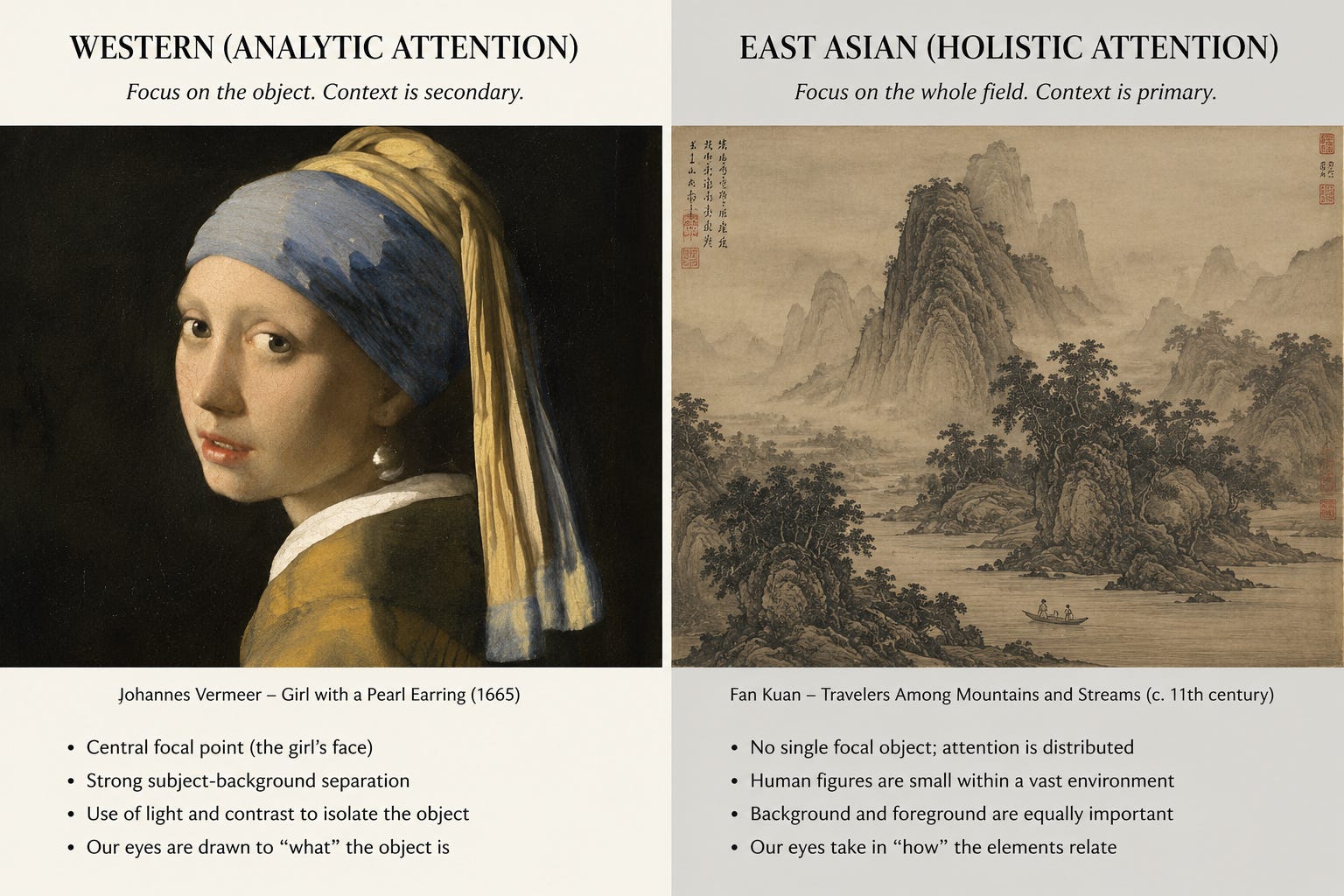
It’s very clear that our focus lies on different elements of space. Even in yourself, you can understand how the brain latches on to different properties and phenomena occurring in your visual field; the way our eyes will interact with visual information influences how you move within the environment, from smooth pursuit, tracking moving objects, to saccadic rapid movement assessing threats. As an example, take any horror movie that uses light, angles, and camera work to transform a perfectly ordinary house into a haunted manor.
These “limits”, quirks in our perception3 delineate the cultural, physical, and personal boundaries that make the human experience possible.
So, what does that mean for you and me? Well, first of all, boundaries aren’t a mere cognitive fart of the human brain. They represent something tangible, natural and unavoidable.
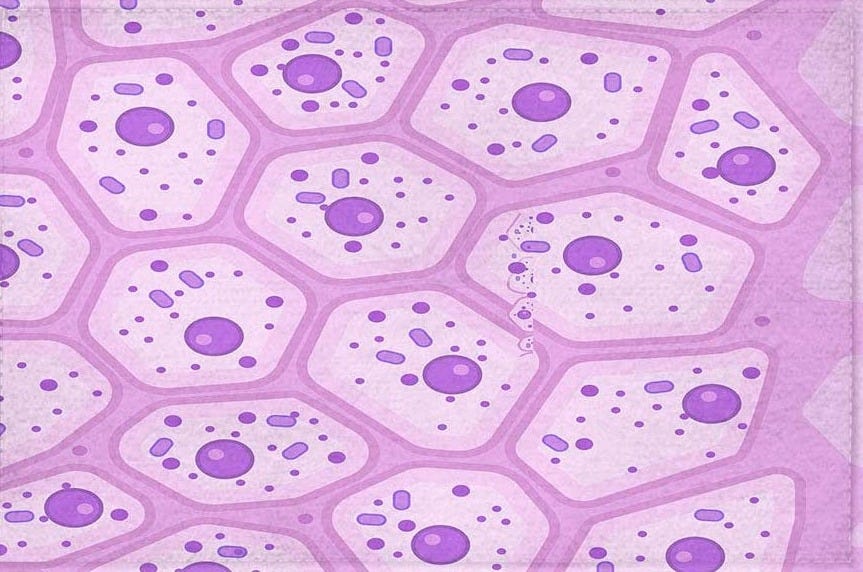
Cells have a phospholipid membrane that regulates what gets in and what gets out, including ions, steroid hormones, vitamins, and gases. Their function relies on these firm boundaries; disruption means the death of the cell. In fact, everything inside your body has discernible barriers that are necessary for life. Without them, everything begins to degrade.
It’s not unreasonable to extrapolate that to every aspect of nature:
In order for anything to exist, it must have a limit that delineates where it begins and where it ends. You, as an individual, are no different.
While new age philosophy and simplified Eastern concepts of noself have become earworms in all conversations pertaining to ontology, as long as you’re occupying physical space you are an entity. There are lines that you can readily trace and conclude you’re a human and they’re rocks and trees and animals. More importantly, we’re different from a human next to us. We can touch them and they can touch us, but we remain a separate entity4.
That’s important for our sense of self. Take the pathological narcissist, for example; the idea that the narcissist lacks an ego appears antithetical to the phenomenology of such a personality disorder, but it’s precisely the lack of discernible boundaries that motivates one to control and manipulate others. If I can’t tell where I end and you begin, surely I’ll start thinking I own parts of you!
A similar mechanism that can weaken the core self is being exposed to thousands of ideas that attempt to hijack or enforce narrative cohesiveness. Social media does this by osmosis, but it can be achieved directly. Cults and religious fanatics are very good at this: by breaking down your boundaries, they can easily gish gallop, cognitively speaking, their way to a new sense of self you didn’t choose.
These are all pathological manifestations of an otherwise natural instinct, Will to Space.
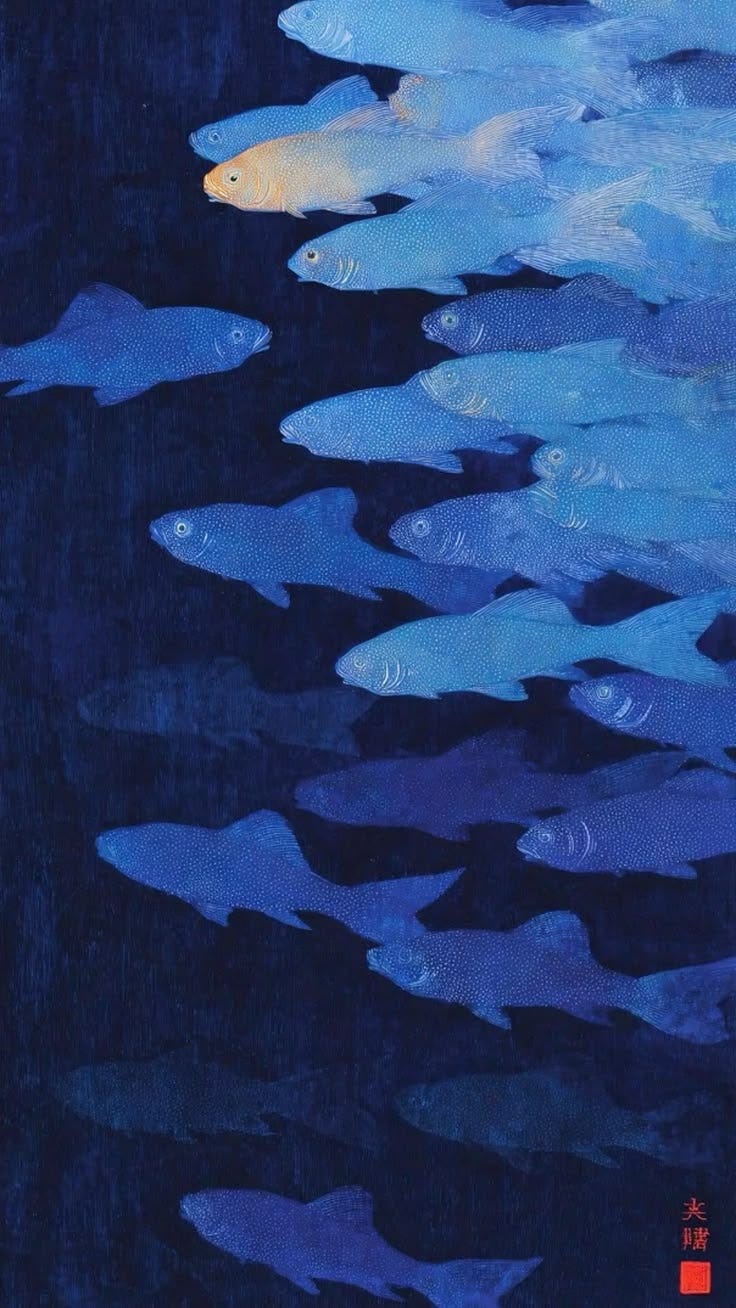
It’s a major drive in our evolution. Reproducing, creating sprawling cities, terraforming earth, and seeking to inject our sperm5 into the universe are testament to this powerful urge to compete for space. We do so because we understand where we end, where our lot stops, and where the “other” begins.
On a smaller scale, you can observe the way people walk, sit, talk, move around. How much room are they occupying? How are they constricting or expanding depending on shifts in social dynamics? What clothes are they wearing, how loud are they talking, etc. People are constantly recalibrating their relationship with their immediate environment trying to contextualize their position and ability to maintain their terrain; while this push-pull dynamic isn’t at the forefront of our consciousness, it does influence us unconsciously.
That’s the obvious physical boundary manifesting in the social order. When you can adapt, remain unfazed by “threats”, or even thrive, you could say that your physical boundaries, which are to a large degree downstream of your psychological boundaries, are strong and healthy.
When these lines are faint, we regress to protozoic life forms that exist on a collective spectrum of sliding consciousness and proliferate in a chaotic manner that resembles amoebas.