

Hypervigilance
Escaping must become your #1 priority

If you suspect that you’ve been living in a state of hypervigilance, I suggest you stop what you’re doing and read the following right now. It’s your life we’re talking about.
The last time you felt truly alive, you were loose, free, open, receptive, expecting great things from the future. Nothing was registered as a threat, but everything was seen as opportunity. Your environment was free of limitations; there was nothing in it that you couldn’t perceive, there was no latent danger in your field of awareness. A sense of ease and connection verging on exhilaration, a compounding satisfaction like sighing after a good meal. Light and spright, ready and available to move and do stuff.
Even reading this paragraph felt good, right? Unfortunately, the opposite is more likely to happen if your nervous system is fried, shot, and on the edge :(
Hypervigilance is the word most people are looking for when they feel uncomfortable, agitated, anxious, fatigued. It describes a state of mild, yet noticeable nervousness. The inability to relax, bracing, racing thoughts, and constantly scanning the environment for threats are the hallmarks of hypervigilance.
Usually related to PTSD, in recent years we’ve seen a huge uptick in the subclinical state of sustained hyperarousal. I hope you aren’t one of those people suffering from it…
But if you are, your #1 priority in life right now should be to escape this mental prison before it leaves a permanent mark on you.
Origins
You’re walking down the street, minding your own business, and someone suddenly taps your shoulder. You jump up, brace yourself, and take a sharp inhalation. These are ways your nervous system is preparing to react and escape a dangerous situation.
It’s healthy and natural to have a swift response to danger. Yet, most people walk around with the expectation that threats are lurking behind every corner. It’s not usually a conscious decision but rather an unconscious defense mechanism. This “excessive” reaction to potential threats can install a chronic pattern that we name hypervigilance.
Then, even in a safe environment, the pattern is still running in the background, influencing your life in ways you can’t immediately notice.
What brought you to that place is complicated since mental and physical causes are intertwined, creating a feedback loop. But we can attempt to follow Ariadne’s thread and retrace our steps until we identify the major root causes. From there, it’s simple (though not easy) to navigate towards a healthier and self-assured attitude.
The eyes, Chico, they never lie.
Find an object a few feet away and another object close to it. Try to move your gaze in one smooth motion between the two.
You will find out that your eyes are making multiple mini-jumps from one object to another. While you don’t actually notice it due to saccadic masking1, your eyes are rapidly sweeping the visual field with these back-and-forth movements. If an object is in motion, your eyes will follow in smooth pursuit, fixating on the object and tracking its behavior.
We switch between these two types of vision constantly throughout the day but darting eyes are the physiological signature of hypervigilance — they reflect a nervous system prioritizing constant scanning and guarding.
Now, your eyes are attached to that thing we call a brain. Most people have it. If you do, then you know that it’s the control panel of your body. In this case, the eyes are obeying the orders of the nervous system and how it reacts to stimuli:
We know for a fact that anxious people perform much worse in anti-saccadic tests. And we also know that CO2 and hyperventilation are tell-tale signs of anxiety. These connections point to how breathing plays a role in generating excessive response to stress. Someone with calm, slow breathing and higher CO2 tolerance2 will fare better in challenging situations but more importantly, they’ll be able to return to the baseline of security much faster.
Someone predisposed to hyperventilation has a lower threshold for getting overstimulated, nervous, or exhibiting other neurotic traits — it takes less to lose it. Specifically, inhalation of 7% CO2 results in lowering saccadic inhibition, meaning more “fixation” and hypervigilance against the negative stimulus. If you task someone to “not look at this peripheral target” they'll look at it more frequently after inhaling CO2.
It’s very much possible to improve the robustness of your nervous system by following a breathwork protocol, specifically my own BreatheLess Practice.
Rest more
Relax. Take it easy. Rest.
This kind of advice sounds reasonable prima facie, but it’s useless. It’s a tautology that basically says, “The way to stop X is by stopping X.” If you understood the concept of levers, you already know something is missing. What’s missing here is energy.
It sounds like a paradox but when your body isn’t getting the nutrients and care required to function at an optimal level, it starts eating itself. Even worse, it compels you to seek food and safety by upregulating adrenergic processes that involve adrenaline, cortisol, glucagon, glutamate, etc.
Feeling safe physically requires a nutrient surplus and enough calories. When you start producing more energy, your body can finally rest because it doesn’t need to be doing anything else.
But there are more physical culprits. Specifically, lack of oxygen on a cellular level.
Chronic stress means chronic hypoxia
It sounds dramatic but it is, unfortunately, true and ties back to the previous sections.
The more stressed and depleted you are, the more lactic acid3 you’re producing at rest. Your body is anticipating danger, and so it prepares to bolt at any given moment which results in lactate production.
Producing some is normal, especially during intense physical exercise that demands rapid energy. However, at rest, relying heavily on glycolysis for energy is metabolically costly and inefficient, as it bottlenecks ATP production.
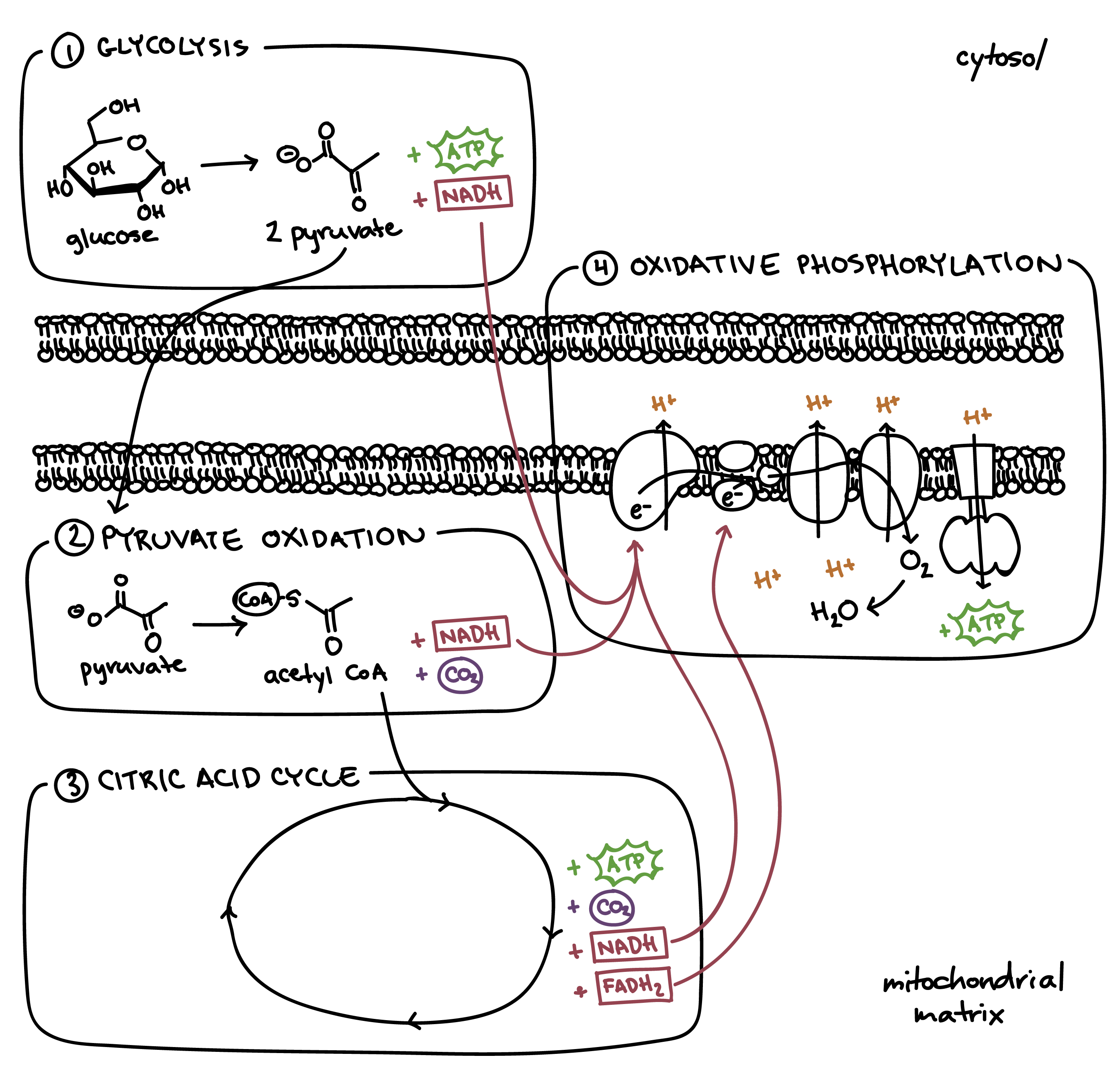
When cellular respiration is optimal, meaning glucose is fully oxidized through glycolysis, the TCA cycle, and oxidative phosphorylation, we produce carbon dioxide as a natural byproduct. This CO2 is not just waste: through the Bohr effect, it facilitates the release of oxygen from hemoglobin into the tissues where it is needed most. The excess CO2 is then transported back to the lungs, where we exhale it as part of maintaining proper acid–base balance in the body.
But we can’t exhale lactate! Yet, lactate and H+ increase respiratory drive, meaning we end up exhaling more and more CO2. Long-term, it creates a hypocapnic environment and hypersensitivity to CO2 that impairs cellular respiration and energy production. The nervous system shifts toward a sympathetic state.
In the Big Buteyko Essay, I go over the effects of CO2 in the body. You should check it out.
Brace Yourself
The nervous system plays a huge role in how you perceive the world. Two different people can witness the same event but have vastly different experiences. It’s the state of their NS that will determine whether they’ll get traumatized, freeze, process, or act.
The ability to quickly metabolize experiences and then let them go is a key marker of a healthy mind and body. By embracing the sensation an experience triggers, you let the body have a natural, healthy reaction. A good example is getting into cold water:
The shock, the shaking, the tremors can feel too much but if you then tense more against them, the entire experience will be extra miserable. Instead, allowing everything to happen will make your body feel less vulnerable and safer.

(Keep in mind that suppression and dissociation are exactly the opposite of what we want. Suppressing emotions is another form of tension, and how are you going to let go of tension with more tension?)
Feeling Secure
“The abdomen is the reason why man does not readily take himself to be a god.”
Nietzsche embraces the needs and desires of man. Today, we suppress or find lesser alternatives to cope with our desires. So much so that embracing our felt, somatic sensations is terrifying. It’s much easier to turn to asceticism or moralize our needs than to attempt to sit and feel the negative, uncomfortable emotions.
We’re rarely secure because we’ve taught our bodies to hide what it really wants. The self rebels against the organism, only for the organism to shut down and rot from the inside by making everything that is “you” fester in favor of a socially acceptable facade.
Opening up means that we become receptive and willing to engage with reality as is. The restricted body, quite literally, begins to expand and release what was stored and hidden in order to protect the fragile You. It doesn’t need to scan the environment for potential threats anymore, because it feels confident it can handle anything that comes up.
Hyperstimulation
Standalone essay on brainrot coming soon.
Releasing Stored Emotions
In the Reich and Lowen tradition, the pattern of “bracing” and holding in emotions is thought to create an armor wrapping around the body. Consequently, only the most powerful desires find ways to slip through the cracks of that armor and manifest, which are usually “bad” and addictive behaviors.
But there’s a more productive way to let go of that shiny, yet crusty emotional exoskeleton.
(Static) stretching
Trauma Release Exercises (TRE)
1) For the longest time, we thought of stretching as a way to literally stretch muscle fibers. But that’s not actually possible beyond some minor long-term adaptation of the sarcomeres. Instead, when we’re stretching, we’re stretching our nervous system4.
We train ourselves to be comfortable in the new range of motion by maintaining calmness during physical discomfort. Given that the nervous system is a direct communication line between mind and body, the effects are upstream. What happens to your body will happen to your mind and vice versa — we want to cultivate the right mental qualities when we’re stretching:
Instead of mindlessly hinging left and right and just applying force to bones and tissue, we saturate the entire body with the fluid of the mind and observe; when you feel the first sign of discomfort, stay in that range of motion for a few seconds and try to prevent your mind from panicking (this is where breath control comes in handy). Then, return to your original position and try again, this time pushing a little further but applying the same method.
2) TRE on the other hand goes deeper. It targets long-held, turbid emotions that have roots beyond your conscious mind. Memories, trauma, automatic patterns are stored in your unconscious mind. And guess what? It’s your body that hosts a huge part of the unconscious mind. As long as you don’t investigate and release what’s inside, it’ll come up in ways you don’t understand, preventing you from relaxing completely5.
The mechanism behind TRE isn’t straightforward but in my opinion, it involves exhausting certain muscles like the PSOAS until they give out and start spasming. The neurogenic tremors release tension. In general, the body acts as a repository that temporarily stores unwanted, complex, and intense emotions and thoughts. When the unconscious spills over, movement happens.
Read this essay for basic instructions and guidelines:

Balancing Yin and Yang
Out of the Greatest Yin comes the Greatest Yang.
There’s a tendency to view Yin as a flaccid, loose, and deflated state. But in reality, Yin has a magnetic quality; it organizes, gives form, provides structure and shape.
Qigong theory states that there’s “bad” or turbid energy that is basically yang qi without the supporting yin qi. When it goes haywire, it stimulates the nervous system beyond capacity. Long-term, it fries and depletes the body. You can actually observe how this pattern manifests in your life if you fast regularly, consume excessive caffeine, and spend a lot of time in front of screens.
The “relaxing” part of yin is overstated, since it comes from the perspective of downregulating the activation of yang. While this is necessary at times, if you want to move beyond hypervigilance for good you must stop thinking in terms of shutting off and retreating from the world; that’s just another reaction to hyperarousal!
Instead of trying to do things that are absent of yang, it’d be more useful to do yang things under the guiding force of yin. Action that aims to build, nurture, create vs. action that tries to minimize pain. Action that goes against the debility-dependency-dread state, otherwise known as learned helplessness.
The best way to accomplish that is to make more decisions faster.
A few notes on making decisions that collapse upon themselves and OCD:
Many excessive behaviors, anxiety, ADHD, addiction, etc can be linked to dysfunctional/impaired activity in the prefrontal cortex, though to what extent it's a robust, cause-effect connection, I can't say. But what piqued my interest was noticing how people suffering from OCD were also indecisive.
If you Google something along the lines of “OCD and indecisiveness” you'll find some interesting but rather timid conclusions. The juice is in the anecdotes in reddit communities and forums but I also have a personal experience.
I have a friend with ADHD caused by OCD who began making drastic changes in their lives after hopping on medication. Not many things in the literature could help me make sense of it. Guilt, shame, insecurity because of their pathology could be used as excuses as to why this person never moved to a different house or switched careers until now but to me, it was something else. Which brought me to the following realization: when you have OCD, situations that don't require a decision suddenly do.
Imagine that you're sitting in your room, doing basically nothing. You perceive your environment as is, not requiring your input or judgment. OCD splits that environment into A and B (and C and D, etc.), burdening you with an unnecessary decision manifesting as intrusive thoughts that need resolving or the drive to perform routine, compulsive behaviors. These don't appear like decisions but they are since they're separated from the neutral state of awareness and manifest without an anchor to a specific outcome. So, in situations where you aren't required to make decisions, your nervous system is burdened to take action that will have no effect outside the enclosed loop of compulsion«—»anxiety«—»relief.
OCD is the most severe form of hypervigilance because it’s a pure state of self-generating negative stimuli.
Relationships and Culture
It’d be easy to focus on what the individual is doing wrong but culture and your extended environment can make or break you.
In The Minimal Self, Christopher Lasch notes a shift in the expression of narcissistic culture. Instead of showcasing the usual grandiosity and validation-seeking behavior, the self now shrinks and prepares for impact. Relationships are considered high risk, threatening the self with annihilation, which in turn pushes it toward an introverted, defensive stance.
The world around us feels more hostile. People, due to uncertainty, develop surface-level, ephemeral, and purely transactional relationships.
Communities weaken when we prioritize self-protection over connection, opting for safety over intimacy. Cultural norms begin to reward caution, conformity, and image management. Social media amplifies this effect, offering curated interactions that feel safe.
The nervous system of a society mirrors the nervous system of the individual: constant alertness, hypervigilance, and low tolerance for discomfort become normalized, breeding even more hostility.
It’s not uncommon to stay in a hypervigilant state for years. As I’ve mentioned, even when the initial threat is gone (hostile environment, pain, health issues, mental anguish) excessive sensitivity persists. Some people experience serious personality changes as a result.
It’s vital that you uproot the mental patterns that stay long after the immediate danger has come to pass.
Hypervigilance blurs reality. It casts shadows where there’s light and transforms all decisions into covert attempts at self-soothing. Escaping that pattern can take time because there are always unconscious, deep roots that sabotage your efforts to get better.
You’ll know you’re making progress when:
Intrusive thoughts and compulsions stop.
Relaxation is possible.
Short time between thought and action.
You’re energized and hopeful for the future.
There’s a sense of ease around most people.
Your desires are focused on what you want, not what you want to avoid.
Toxic relationships naturally end.
Almost zero anticipatory anxiety.
You can sustain habits easily.
Less addictions.
Less compulsive, repetitive behaviors.
Good luck.

P.S. I could’ve written a lot more about the subject but for the sake of keeping this essay under 3,000 words, let’s leave it at that. In the future, I’ll try to add more sections as I see fit, so I suggest you bookmark this page and revisit from time to time.
A natural phenomenon where the brain selectively blocks visual processing during rapid eye movements, or saccades.
It’s a little more complicated than “CO2 tolerance” but for the sake of simplicity, let’s leave it at that. The essay I link provides a thorough explanation.
Technically the human body doesn’t produce lactic acid but rather lactate and hydrogen ions.
Check out the work of Katy Bowman, as well as this article.
I believe relaxation induced anxiety, associated with PTSD and depressive disorders, is in part caused by stored, unconscious tension.
Hi Hyde,
I'd love to hear more of your thoughts on CO2 and CO2 tolerance. As a person who's had asthma for as long as I can remember, I would particularly appreciate if you cared to expand a bit more on the thoughts surrounding CO2 and breathing.
This comes in interesting point of time for me, as only very recently, I have, after maybe a decade, been for the first time able to breathe in fully (as normal person would, lol) without any medication. I found out exercising+running+CO2 monitoring daily treats my asthma completely. I had no idea how much CO2 rises above the 1000 mark during the night, and also during the day, if one does not vent and have open windows rather frequently.
So long story short, I wonder about the CO2 tolerance you mention and would love if you could expand on it.
Cheers, and appreciate your articles. Keep it up! :-)
Ahh man this essay makes me sad. I have been in this state the vast majority of my life, and had a few glimpses for months at a time of what it could be like NOT to be hypervigilant.
I have to say, I am bitter about it. I appreciate the sentiment here, I do want to try and get better.